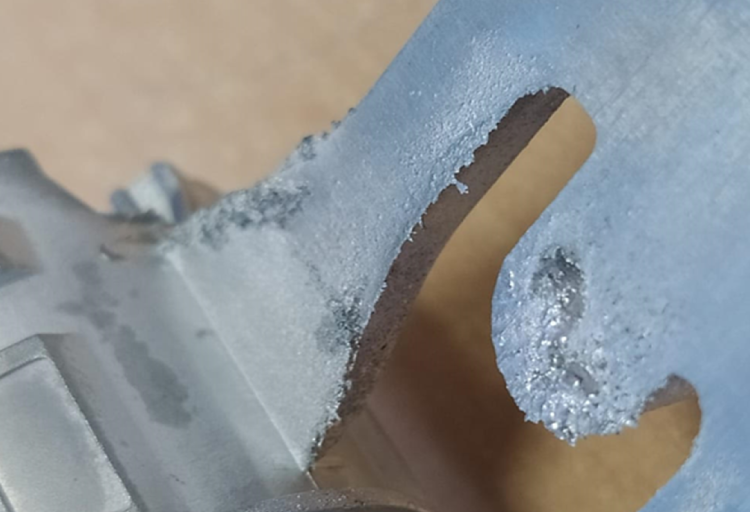
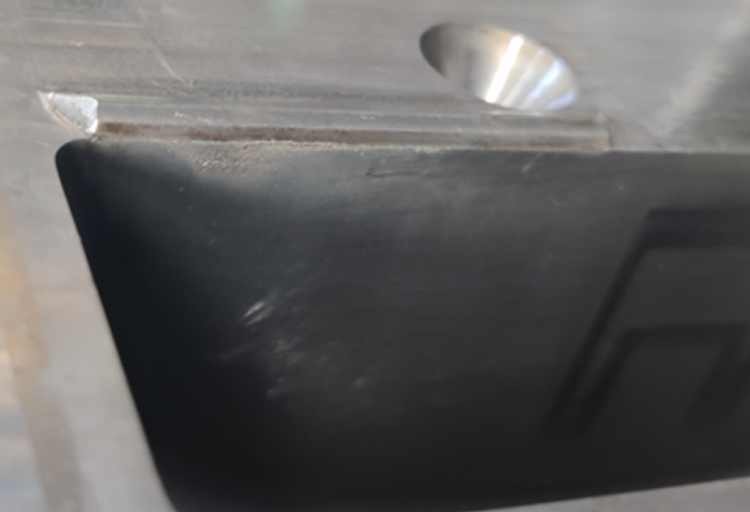
Cavitation is a form of mold erosion that occurs during casting. In some critical areas of the dies, steel is removed and eroded by an aggression generated by micro-implosions of gases and vapors that occur during the filling of the cavity.
The rapid deterioration of the dies results in production stoppages and major maintenance operations that compromise the production efficiency.
How to prevent cavitation?
In the molding of articles by means of zamak die casting, considerable difficulties can arise in achieving the surface quality of the casting to meet the customer’s aesthetic requirements.
In order to achieve a good surface quality of the die casting, i.e., without marbling, it is necessary for the liquid metal to reach all areas of the impression as quickly as possible and without yielding temperature. Hence the need for high pressures and high flow velocities in the filling phase.
High pressures give rise to the phenomenon called “water hammer” at the end of the filling phase, while high velocities generate flow turbulence, both of which are crucial factors in the occurrence of cavitation.
We have found in our experience that using liquid zamak injection speeds below 60 m/s significantly reduces the occurrence of the phenomenon in the mold surface – an important fact to consider when designing the mold and the process.
The use of simulation programmes to fight cavitation
A very useful tool used daily in Bruschi’s engineering area is simulation software.
With these programmes, the engineering team can simulate the filling of the product in order to design casting and vent channels capable of achieving the quality required by our customers without, however, causing premature deterioration of the mold.
During the realisation of projects, from the design phase to the production phase, with the simulation software it is possible to prevent all possible defects on the mold. In this way, Bruschi can to save time by predicting possible problems, achieving customer goals in the best possible way.
These simulations are of such importance that they are also taken into great consideration during the bidding phase to the customer, as they prove essential in anticipating any eventuality.
Conclusion
The aim of engineering is to solve the cavitation problem by studying the behavior of the fluid inside the molds on a daily basis. These evaluations are carried out using simulation software, with which Bruschi can visualise parameters such as flow velocity, pressure inside the mould and filling temperature of customer products.
Considering that each product has a unique geometry, different issues and new daily challenges arise and are addressed to ensure quality products for the Bruschi team and its customers.